
Searching Clinton County Civil Dockets
Civil dockets in Clinton County split by court. Pick your lane first. District civil cases, small claims included, run through the MiCOURT 65A search. Circuit civil cases take the county's Circuit Court Case Inquiry and the County Clerk route. The county puts Circuit filings from after 1996 online. Anything older than July 1996 goes through the County Clerk's process for older records.
Search by party name when the case number is a mystery. MiCOURT asks for a Last Name or Business Name. Then narrow things with a first name, middle name, or birth year. If the number is known, year, number, and type will pull the matter up. Clinton County publishes no plain-language code for civil case numbers. Copy the number from any notice or record. Ask the clerk when the type is unclear.
- Identify whether the civil matter belongs in 65A District Court or the Clinton division of the 29th Judicial Circuit Court.
- For a 65A case, select Clinton 65A in MiCOURT and choose either the name or case-number search panel.
- For a Circuit case, use the county inquiry route and the County Clerk fallback when the dynamic search handoff does not work.
- Open the matching public register and compare the court, case type, party role, filing date, and status before relying on any event.
- Contact the relevant clerk for a filed document, an older record, a public copy, or certification.
Note: MiFILE is for authorized electronic filers. It is not the everyday public viewer for a Clinton County civil Register of Actions.
Clinton County Civil Court Choice
Which Clinton County civil docket holds your case comes down to jurisdiction. The 65A District Court owns civil claims up to $25,000. Its docket also includes small claims, garnishments, summary proceedings, land-contract and mortgage foreclosures, and other district matters. The 29th Judicial Circuit Court takes civil cases above that line. Its reach adds appeals, injunctions, condemnations, license restorations, and general civil work. Family and Probate files travel their own court paths, and public access can differ there too.
This is routing, not a verdict on the claim. Search the wrong court and you may get nothing, even though the file sits somewhere else. Clinton County routes Circuit civil filings through the County Clerk. Meanwhile 65A runs its own Civil Division. Appeals and transfers can also leave a related record behind in the receiving court.
| Clinton civil matter | Court and record keeper | Primary route |
|---|---|---|
| Claim within the district limit, small claim, garnishment, or summary proceeding | 65A District Court / Civil Division | MiCOURT 65A; Civil Division at 989-224-5152. |
| General civil claim above the district limit, injunction, condemnation, or appeal | 29th Judicial Circuit Court / County Clerk | Circuit inquiry and County Clerk at 989-224-5140. |
| Estate, trust, guardianship, or related probate petition | Clinton Probate Court | Probate office, not an ordinary civil docket route. |
The 29th Circuit Court page identifies its Clinton civil division and filing-office route.
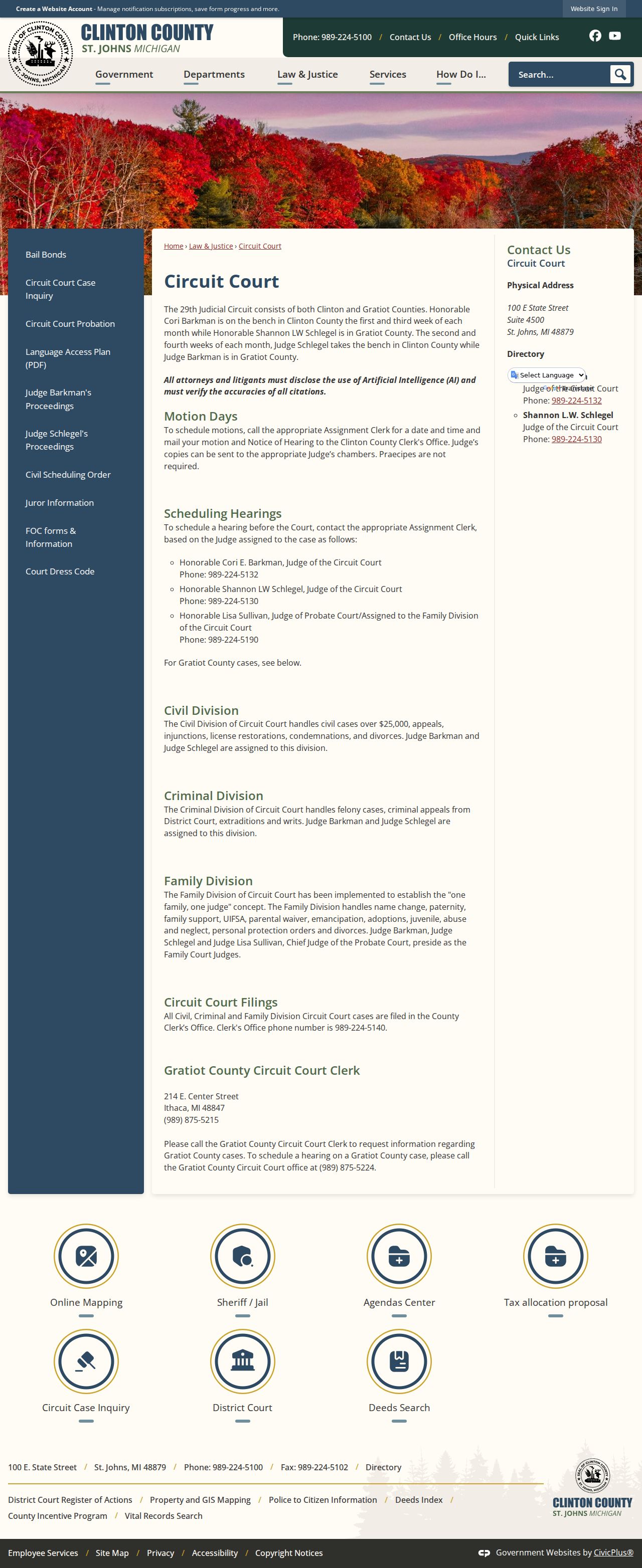
The division listings point the same way. For a Circuit civil filing or a Circuit court record, the County Clerk, not the 65A Civil Division, is the right contact.
Inside a Clinton County Civil Docket
Open a Clinton County civil ROA and the identifiers come first: court, case number, filing date, case type, status, and the assigned judge when the display shows one. Parties follow, with plaintiff, petitioner, defendant, respondent, attorneys, or businesses listed as the case type allows. From there the event history unfolds. A complaint or petition, summons, answer, motion, order, mediation, hearing, judgment, and post-judgment activity may all appear in turn.
Read each entry with care. Not every public register carries every field. A filing date is not automatically a hearing date. A judgment amount, balance, or garnishment marker is not a clerk copy fee. Public history can point to a filed document, but images, redaction, reproduction, and certification all rest with the court that keeps the record.
| Case identification | Use the court-assigned number exactly. The 65A search uses Year / Number / Type components rather than a published local civil format. |
|---|---|
| Parties and counsel | Public entries may show plaintiff or petitioner, defendant or respondent, business, and attorney relationships where available. |
| Filed events | Read complaint, petition, answer, response, motion, notice, and order entries by their event dates. |
| Settings and ADR | Look for hearing, mediation, alternative-dispute-resolution, date, time, room, and related calendar information. |
| Outcome and finance | Public judgment, disposition, costs, balance, garnishment, or satisfaction fields can be limited and must be read with the entry date. |
Clinton County Civil Register Events
A civil register is a timeline, and each entry plays its part. The complaint or petition opens the case. A summons, notice, answer, or response marks the next public step. A motion asks the court to act. Its hearing is a separate event. The order that follows records what the court directed. Mediation, alternative dispute resolution, judgment, dismissal, or satisfaction entries can mark later phases. The sequence varies case by case, and no single entry tells the whole story.
Clinton County keeps two public paths. The county's online-services materials spell out the difference between Circuit Court Records Inquiry and District Court ROA Inquiry. That matters when a party shows up in both. The county search hub notes that the 65A Case Search/Inquiry displays the public Register of Actions. Circuit material runs through the Circuit inquiry and the Clerk. The Clinton County court-search hub lays out these separate District and Circuit routes.
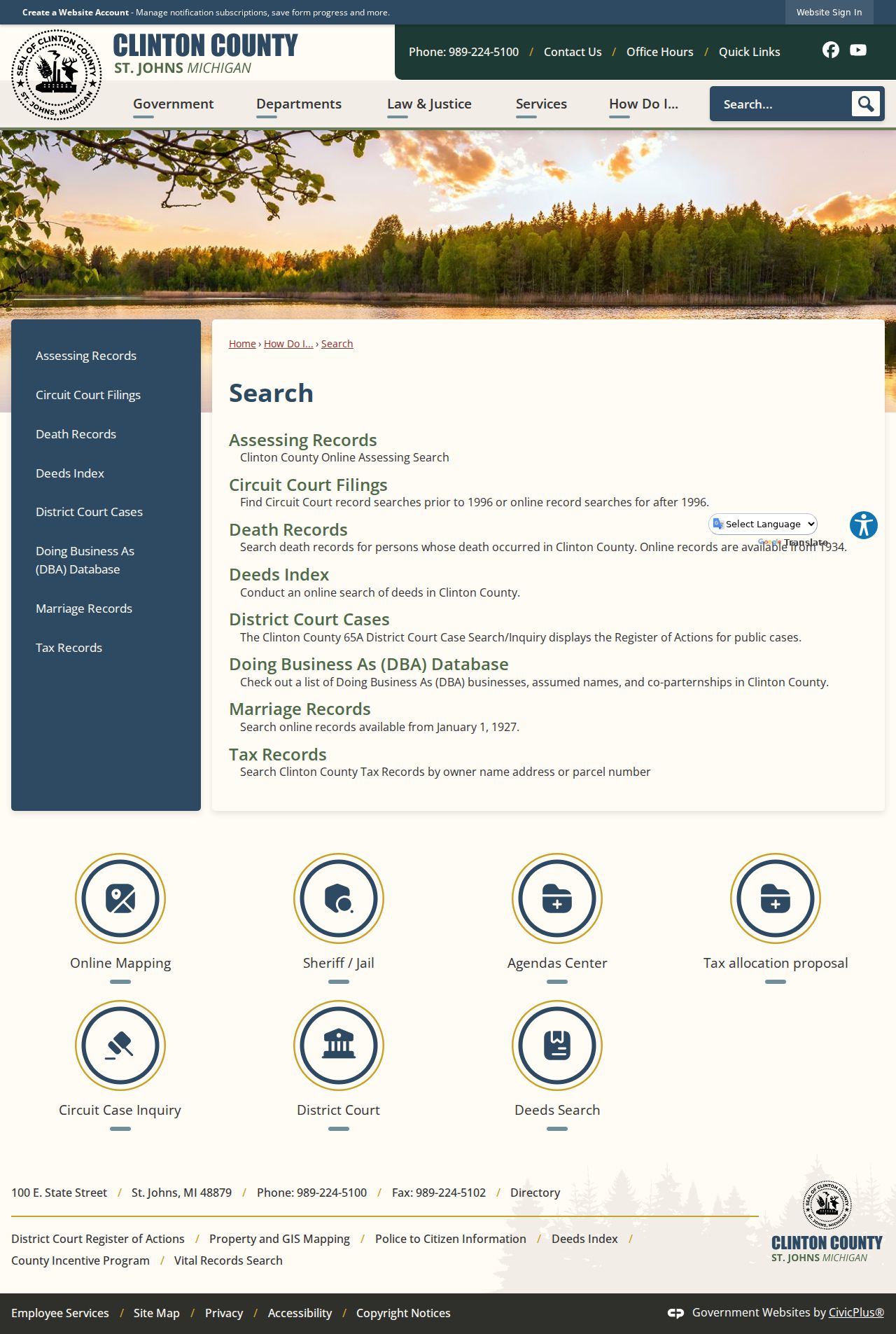
Match the search route to the court on the case. One public page does not cover every Clinton County civil record.
Civil Case Types on the Docket
Clinton County's civil registers divide by case category and court limit. The 65A page covers civil litigation within its jurisdiction. Small claims, summary proceedings, and garnishments sit there too. Circuit Court lists broader civil jurisdiction, appeals, injunctions, condemnations, and family divisions. Probate records stay with Probate Court. Family or protected categories can carry different public-search limits. The right docket follows the type of matter. It also tracks the dollar threshold and the court assignment.
- 65A civil claims within the court's $25,000 jurisdiction.
- Small claims handled through the 65A Civil Division and Michigan court-approved forms.
- Garnishments and summary proceedings listed among 65A district matters.
- Circuit general civil cases above the district threshold, including injunction and condemnation matters.
- Circuit appeals and certain family matters, subject to the record and access rules that apply to that category.
Small claims and general civil litigation are not the same case type. A party's home address or where an event happened does not override the court's jurisdiction and case assignment.
Clinton County Civil Case Boundaries
Money is the first divider in a Clinton County civil docket search. Claims at or under $25,000 go to 65A District Court. Circuit Court handles the civil matters above that limit. It also takes its listed general-jurisdiction categories. Be careful with dollar fields on a public docket, though. A balance or judgment amount serves a different purpose than the statutory threshold that routes a case between courts. Never use it to place a Clinton County case.
The County Clerk holds the Circuit civil records. The 65A Civil Division answers district civil questions. If the record you want is really a Probate petition or a protected family matter, call the right office. Don't force it into an ordinary civil result. The Michigan District Court jurisdiction guidance lays out the state rules behind this split and shows how the 65A civil division fits within it.
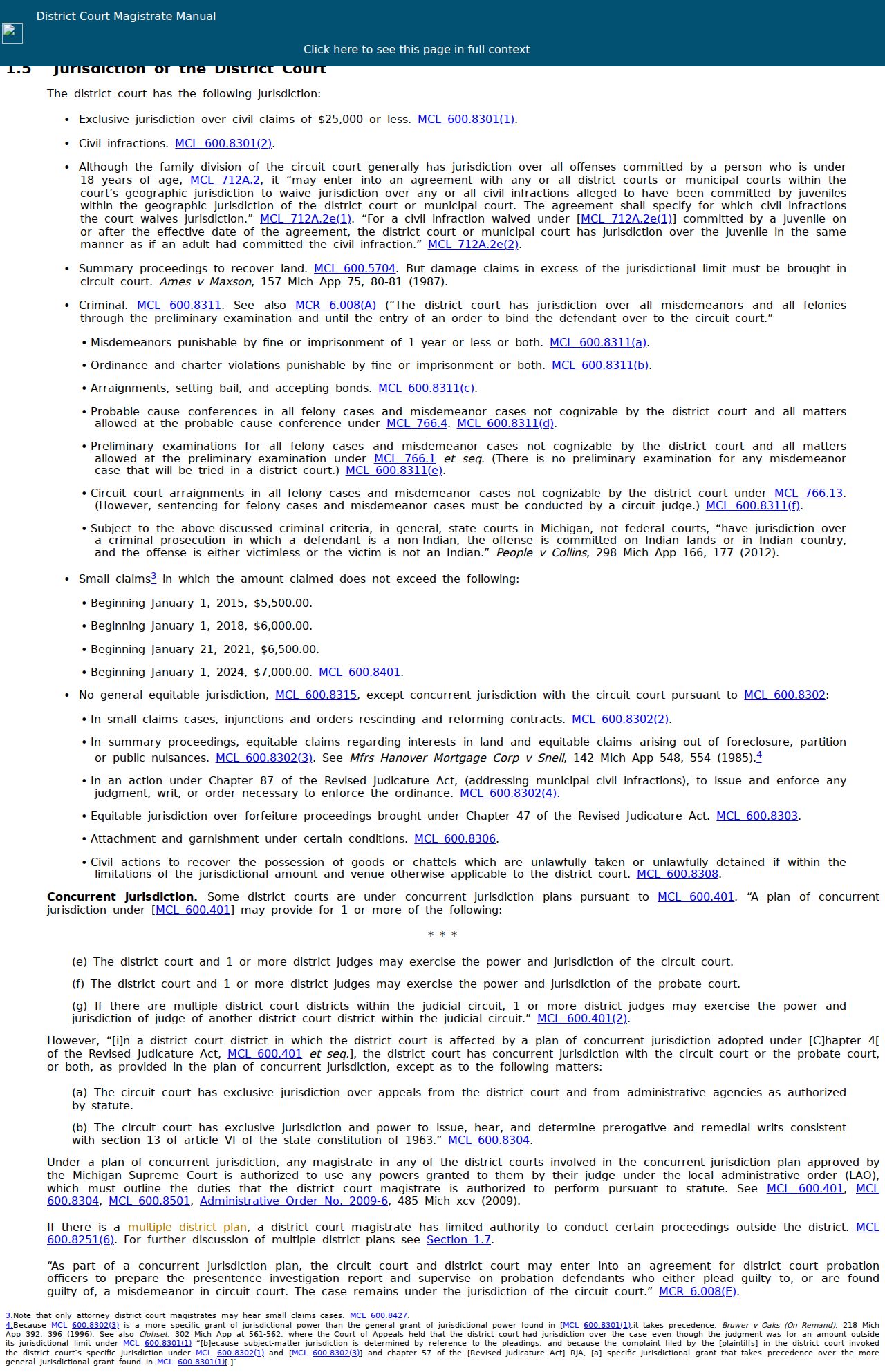
The same logic explains where a Clinton County civil record actually sits. A matter may live in 65A or in Circuit Court, even when both cases arose in the same county.
Civil Docket Settings and Hearings
A civil filing never carries its own hearing date. The event comes from a notice, an order, a motion hearing, or another setting, so check the current case record for later movement. For 65A matters, the county's public District Court Schedule runs on a CourtDisplay view. Columns show Party Name, Time, Room, and Case Number. Match the case number before trusting a same-name calendar entry. The calendar is a lookup aid, not a full case-history database.
Circuit civil scheduling works differently. The county sends parties to the appropriate assignment clerk, motion and notice material to the County Clerk, and judge copies to chambers. There are no praecipes. A continuance, reset, adjournment, or rescheduled event can move the matter, and an older ROA event may stay visible after the current setting changes.
When a date truly matters, compare the latest notice, the case register, and the court's current schedule. Call the court if they conflict. The Court Dates reference details the county's calendar routes.
Clinton County Civil Hearing Checks
Start a 65A civil hearing check with the public District Court Schedule. Also grab the date on your most recent notice. Read the Party Name, Time, Room, and Case Number fields as one picture. Then open the matching MiCOURT ROA. See whether the newest event is a setting, a filing, an order, or a reset. A blank date view does not mean the case closed. A missing line can mean several things. The public view may be limited, the date changed, or the matter sits in another court.
Circuit civil settings run through the assignment-clerk and County Clerk route. The public Circuit inquiry wrapper publishes no static control list. It offers an image-based or dynamic search handoff. It may refuse to open. If so, call the County Clerk at 989-224-5140 with the case year, number, party name, and court division. The clerk can point you to the proper current access route. MiFILE is an e-filing system. It is not a public docket viewer. The Circuit Court Case Inquiry page is the county's official entry point for that online route.
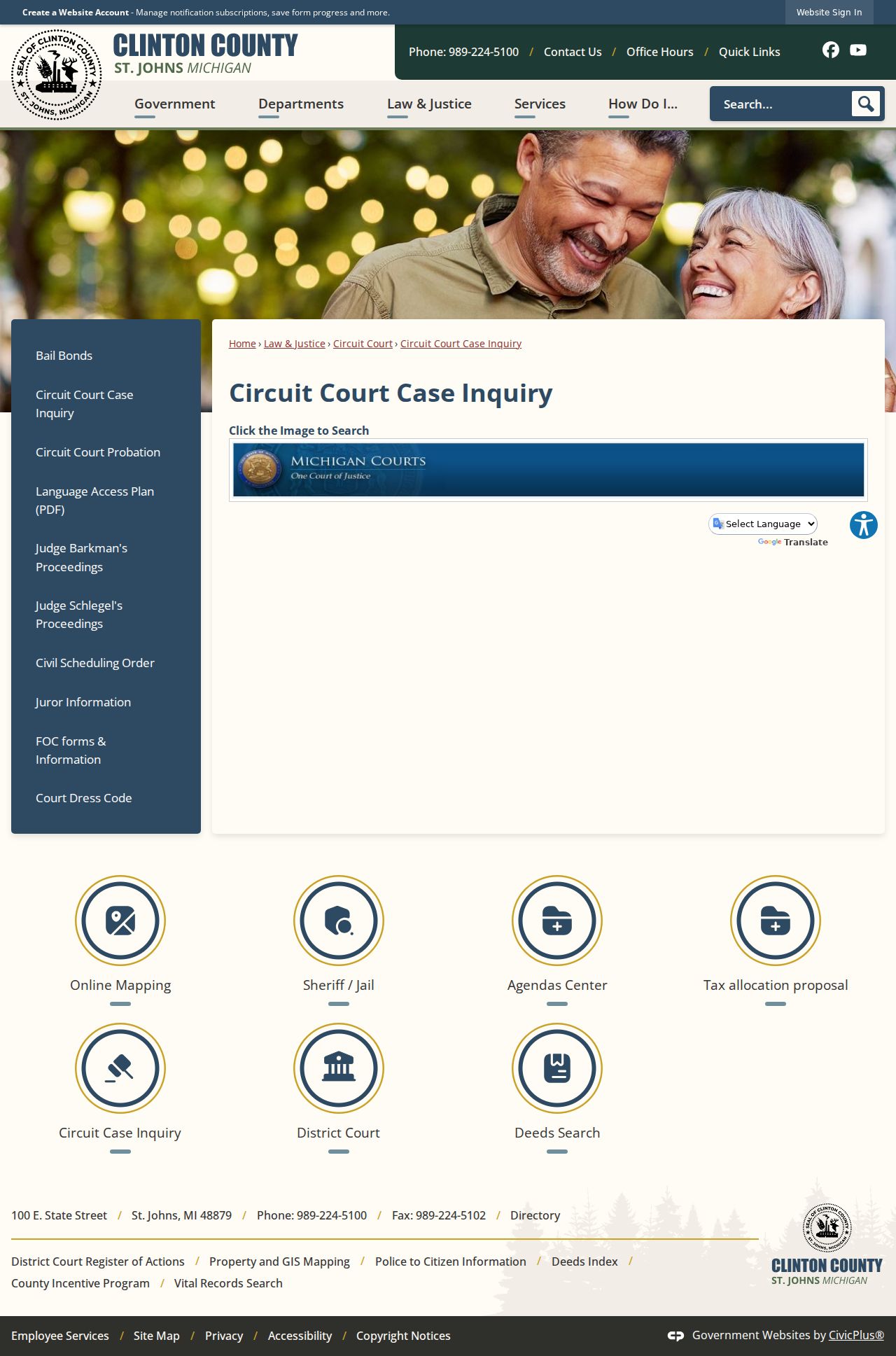
That image-based handoff has a practical cost. Keep the County Clerk phone route ready whenever a Clinton County Circuit civil search stalls online.
Civil Docket Access Rules
Michigan court records are generally open to inspection or copying. A law, rule, or order must say otherwise. The public Clinton County civil register is not the whole case file. MiCOURT can mask protected personal information. A sealed or restricted category may return no public result at all. Courts need not display a record online. That applies when personal information has not been redacted. For the lawful public-access route in a given case, the court or clerk is the authority.
FOIA is not the normal path for a court case file. Under state guidance, the judiciary falls outside the FOIA public-body definition for court records. That includes a county clerk acting as Circuit clerk. Ask for a civil file through the court's copy procedure under the court-record rules. The county FOIA route covers county administrative records only. It does not replace copies from 65A, Circuit, or Probate.
Michigan access rules:
MCR 8.119 provides the public court-record framework, including inspection, copies, redaction, and sealing.
MCR 1.109 addresses electronic filing and official court-record treatment.
MCL 15.231 is the Michigan FOIA statutory starting point, subject to the judiciary boundary described by state guidance.
Clinton County Civil Copy Requests
Clinton County splits its civil docket work between two offices. The case type decides where you call. For a 65A civil case, use the Civil Division at 989-224-5152 or DCCivil@clinton-county.org. Its counter sits in Suite 3400. Civil filings are due by 4:30 p.m. The staff there can help with a civil claim, small-claims matter, filing, copy, or public-register question. Circuit civil cases are different: the County Clerk handles those, at 989-224-5140 or clerk@clinton-county.org. You can request a Circuit record online, in person, or by mail. Follow the county's published record-search instructions.
Copies in Circuit cases carry set fees. Clinton County charges $2 per page for the first ten pages. Then it charges $0.50 per page after that. A certified copy adds $1 per page plus a $10 certification charge. The online ordering path asks for a case number. Picking the wrong court can slow things down. A mail search in Circuit runs $10 per name and covers ten years. In-office searches for records from before July 1996 carry no search fee. MiCOURT lists no official per-document image fee online.
The County Clerk record-search page holds the official details. It covers Circuit search, copy, certification, and mail requests.
Note: Call ahead before faxing or emailing a deadline-sensitive filing or request. Acceptance depends on the court office and the document type.